
Is Buying Backlinks Safe? Risks, Google Penalties and Best Practices (2026)
- #Link Building
- #Google Penalties
- #Link Spam
- #White Hat

Buying backlinks is never completely risk-free, because Google's spam policies treat links bought to manipulate rankings as a violation. The risk is manageable, though. Choose contextual links on relevant sites with real traffic, add them gradually, vary your anchor text, avoid link networks, and understand how Google asks paid links to be labeled.
TL;DR
- Google's spam policies call out buying or selling links that pass ranking signals. That is the official position, and you should know it before you spend a dollar.
- Penalties come in two forms: a manual action (a person at Google reviews your site) and algorithmic devaluation (the link is simply ignored).
- Most real-world damage comes from patterns: link networks, mass packages, sitewide footers, and the same exact-match anchor repeated.
- Safety comes from relevance, real traffic, a gradual pace and varied anchors, plus monitoring in Search Console.
What does Google officially say about buying links?
Google's link spam guidance says that links intended to manipulate PageRank or a site's ranking can be considered link spam, and it lists buying or selling links that pass ranking credit as an example. It also asks that paid links be qualified with rel="sponsored" so they do not pass ranking signals. Both points are in Google's spam policies and its guide to qualifying outbound links.

Other practices Google lists as link spam include:
- Excessive link exchanges ("link to me and I'll link to you")
- Large-scale article or guest-post campaigns with keyword-rich anchor text
- Automated link creation and low-quality directory or forum spam
This is the honest baseline. Anyone who tells you paid links are "100% safe" is selling something. The useful question is not "is it allowed" but "how do I keep the risk low and the links useful".
What are the real risks: manual action vs. algorithmic devaluation?
There are two ways paid links can hurt, and they differ a lot in severity.
Manual action
A human reviewer at Google finds a pattern of unnatural links pointing to your site and applies a manual action, which you can see in the Manual Actions report in Google Search Console. Pages or the whole site can lose visibility until you clean up and submit a reconsideration request.
Typical causes: obvious link networks, sitewide footer links, and pages whose entire anchor profile is commercial keywords.
Algorithmic devaluation
Google's systems, including its spam-fighting systems that have long been part of the core algorithm, identify links as artificial and simply stop counting them. Nothing dramatic happens to your rankings, but the money you spent produced nothing.
Typical causes: links on low-quality, irrelevant or obviously commercial sites. See how to identify quality backlinks to avoid them.
| Manual action | Algorithmic devaluation | |
|---|---|---|
| Who decides | A Google reviewer | Google's automated systems |
| Do you get notified? | Yes, in Search Console | No |
| Impact | Visibility loss until fixed | Wasted spend, no ranking gain |
| Recovery | Remove or disavow links, reconsideration request | Stop buying that kind of link |
How do I buy backlinks as safely as possible?
Safe link buying comes down to not leaving the footprints that trigger problems. These are the rules we follow and recommend.
Rule 1: Context is everything
The link should sit inside a useful article that is genuinely related to your topic. A link to a car-insurance page from a mechanic's tips blog makes sense. The same link inside a cake-recipe site does not.
Rule 2: Vary your anchor text
If every link says "best marketing agency", the pattern is obvious. A natural profile is dominated by your brand name, your URL and descriptive partial phrases, with exact-match keywords as a small minority. Treat this as an illustration, not a formula:
| Anchor type | Example | Rough role in a natural profile |
|---|---|---|
| Brand | "Contentor" | Often the largest share |
| Naked URL | "example.com" | Common |
| Partial or descriptive | "tools for generating SEO articles" | Common |
| Generic | "this guide", "source" | Occasional |
| Exact match | "buy backlinks" | Small minority |
Rule 3: Avoid bad neighborhoods
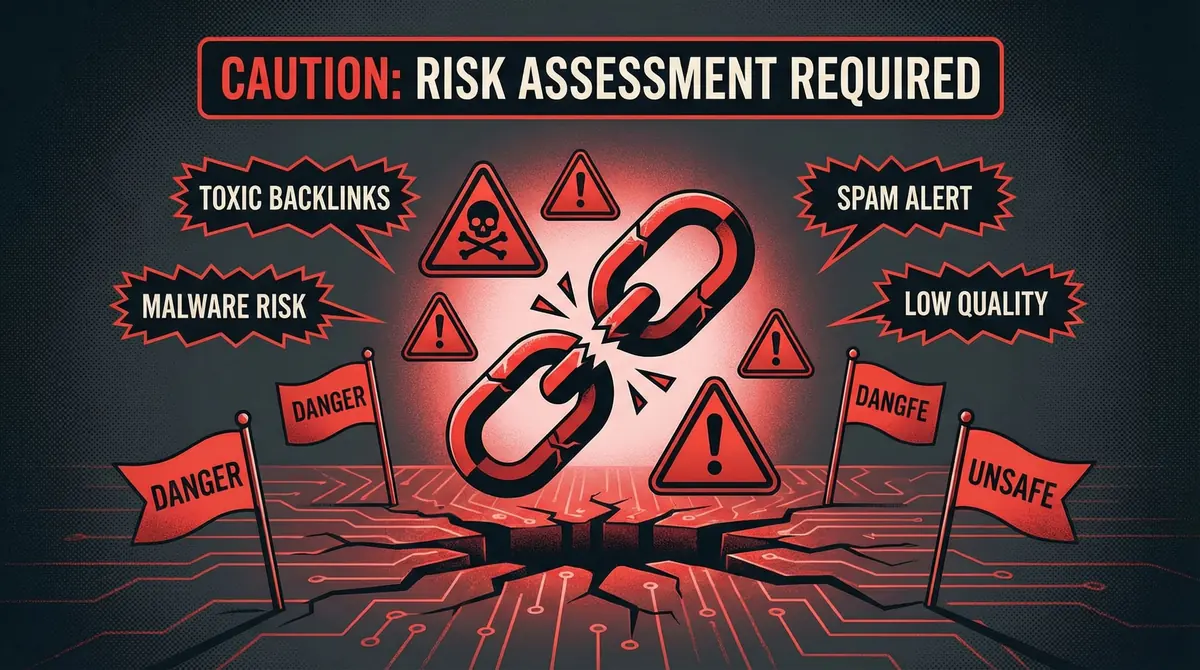
Do not take links on sites that also sell links to casinos, adult content or unrelated products. Moz's Spam Score and a quick manual scan of the site's outgoing links will usually reveal them. Our tutorial on how to check DA and DR walks through the process.
Rule 4: Insist on real traffic
A site that sells links in bulk often has no organic visitors. If Google does not send people to the site, a link from it is worth little. Only buy from sites Google already shows to real searchers.
Rule 5: Go gradually
Dozens of new links in a week stands out. A steady drip from different sites reads as normal growth. For a pacing plan, see link building for new sites.
Rule 6: Point links at useful pages
Do not send every link to the sales page. Support helpful articles and resources too, which both looks natural and helps those pages rank.
What are the red flags that a backlink seller is risky?
Walk away if you see any of these.
- Packages like "1,000 links for $50". Bulk links at that price are almost always spam.
- Guaranteed rankings. Nobody controls Google. Guarantees about placement are reasonable, guarantees about positions are not.
- Public blog networks (PBNs). Networks built to sell links are among the easiest for Google to detect and discount.
- Sitewide or footer links. They look artificial and pass little value.
- No visibility into site quality. You should know the criteria, even if the exact list stays private.
Our pre-purchase risk check: ask whether the seller states a minimum authority, requires real organic traffic, publishes contextually, and offers a replacement guarantee. If any answer is vague, the risk is higher.
What should I do about rel="sponsored"?
Google asks that paid links be qualified, and that is the compliant approach. In practice there is a trade-off every buyer should understand: a link labeled sponsored may pass little or no ranking credit, while an unlabeled paid link carries the policy risk described above. There is no free option, which is why it makes sense to treat paid links as one part of a broader mix that includes earned links, digital PR and strong content, and to judge the investment by traffic and referrals, not just rankings. Weigh the trade-off honestly for your own site.
How do I monitor the risk after I buy?
Keep a simple routine:
- Check the Manual Actions and Security issues reports in Google Search Console monthly.
- Watch impressions, clicks and positions on the pages that received links.
- Review new referring domains in a backlink tool and record every placement.
- If a bad link appears that you did not request, document it before deciding whether to disavow. Google's disavow tool is a last resort, not a routine.
Is buying backlinks worth it compared with other options?
For many sites, yes, when it is one tactic among several. Earned links are slow and uncertain, guest posting needs outreach time, and agencies are costly. A vetted, flat-price service can sit in the middle. See guest post vs. paid backlinks for a head-to-head comparison.
FAQ
Is it safe to buy backlinks?
It is never risk-free, because Google treats links bought to manipulate rankings as spam. Risk falls sharply when links are contextual, on relevant sites with real traffic, added gradually with varied anchors and monitored in Search Console. Mass, cheap, networked links are where most penalties come from.
Can Google tell that I bought a backlink?
Google's systems and reviewers look for patterns such as link networks, sitewide links, repeated exact-match anchors and sites known for selling links. A single relevant, well-placed link is hard to distinguish from an editorial one, but unnatural patterns across many links are easier to spot.
What happens if I get a manual action for unnatural links?
You will see a notice in Search Console's Manual Actions report, and affected pages or the site may lose visibility. You fix it by removing or disavowing the offending links, documenting your cleanup and submitting a reconsideration request. Recovery can take weeks to months.
How many backlinks should I buy per month?
There is no universal number. For a small or new site, a few high-quality links per month is safer than a large batch, and the pace should match how naturally the site could realistically earn links. Increase volume only as you see results and your content library grows.
Should paid backlinks be nofollow or sponsored?
Google asks that paid links use rel="sponsored". The compliant choice is to qualify them, but a qualified link may pass little ranking credit. Many buyers value placements for referral traffic and brand visibility as well as rankings, so decide with your own risk tolerance.
Build links with a safer approach
If you decide to buy, work with a provider that states its quality criteria and backs the placement. Contentor's backlink service publishes permanent links in context on vetted sites with DR 20+ and real organic traffic, with free replacement for six months, and we recommend a gradual pace and varied anchors on every order. To make sure the pages those links point to deserve them, Contentor helps you generate and publish SEO articles and track the results in Google Search Console.
Strengthen your authority for AI Search
Combine source-worthy content with contextual backlinks on vetted sites to reinforce trust, discovery, and topical authority.
View contextual backlinksPrepare your content for AI answers
Create AEO/GEO briefs, entities, schema, and structured articles for Google AI Overviews, AI Mode, and traditional SEO.
Try Contentor free