
Does Google Detect AI Content? How to Avoid a Penalty in 2026
- #AI Content
- #Google
- #Penalties
- #Humanization
- #SEO

Google has never said it ranks pages by detecting whether AI wrote them. Its stated approach is to reward helpful, original, people-first content and to demote spam, including content produced at scale mainly to rank, however it is made. So the real risk is low-value content, not the use of AI itself.
TL;DR
- Google says using AI is not against its guidelines. What it targets is content made primarily to manipulate rankings.
- Google has not confirmed using AI-text detectors for ranking, and third-party detectors are unreliable, with known false positives.
- The real risks are scaled content abuse, thin pages, errors and a lack of experience and trust signals, not "AI fingerprints".
- Protect yourself with human review, original value, fact-checking and a quality bar every page must clear.
What does Google actually say about AI content?
Google's guidance is that appropriate use of AI or automation is not against its guidelines, but using it to generate content primarily to manipulate search rankings is a violation of its spam policies. The position, laid out in Google's guidance on generative AI content, is simple: the problem is the intent and the quality, not the tool.
Google does not object to AI-assisted writing. What it fights is:
- Content produced in bulk with no human review
- Text created only to rank, with no real value for the reader
- Pages that fail to demonstrate E-E-A-T: experience, expertise, authoritativeness and trustworthiness
For the full picture on how AI articles perform, see do AI-generated articles rank on Google.
Can Google detect AI-generated text?
It may well be able to recognize patterns, but Google has not said that it uses AI detection to rank or penalize content, and it has consistently framed its evaluation around quality and helpfulness. Treat any claim of "Google detects AI and demotes it" with skepticism, because it is not something Google has stated.
What is documented is that Google evaluates scaled, low-value content. Since March 2024, its spam policies explicitly cover scaled content abuse, meaning many pages produced mainly to rank with little value, whether written by AI, people or both. That works against thin AI factories, and it is a content-quality issue rather than a detector.
How do AI detectors work, and can you trust them?
Tools such as GPTZero, Originality.ai and Copyleaks estimate how likely it is that a text was machine-written. They typically look at statistical signals:
- Predictability (often called perplexity): how expected each word is. AI text tends to be smoother and more predictable.
- Variation (often called burstiness): how much sentence length and structure vary. Human writing is usually more uneven.
- Style patterns: repetitive transitions, uniform paragraph shape, favorite words.
These are third-party heuristics, not a description of Google's systems. They also produce false positives, including on text written by people, and they are easy to fool with editing. Use them, at most, as a rough editing guide. If you want to see how a text scores, our free AI text detector is a quick way to check, and you can improve flagged passages with the free AI text humanizer.
What are the real risks of publishing AI content?

Risk 1: Scaled, low-value pages
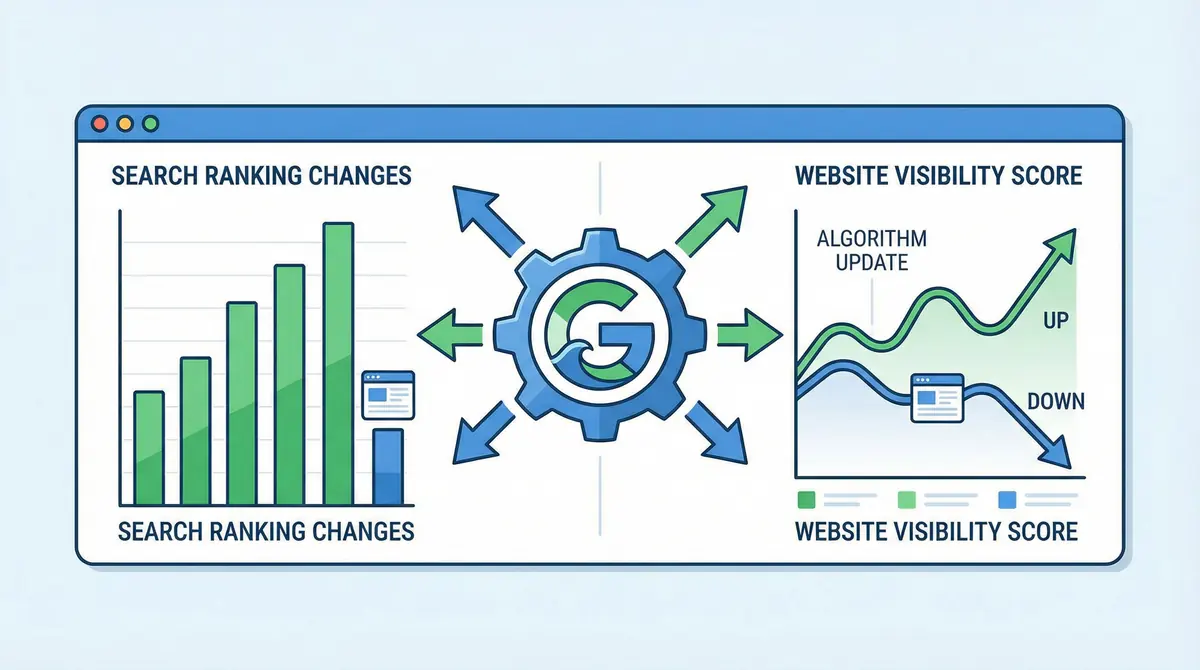
Publishing dozens or hundreds of near-identical, lightly edited AI pages is the pattern Google's spam policies describe as scaled content abuse. Quality is judged across a whole site, so a large volume of weak pages can drag down the stronger ones. We would rather not quote a traffic-loss figure we cannot source, but the direction is well documented: sites that rely on thin, mass-produced content have been hit hard by Google's quality-focused updates.
Risk 2: Factual errors
Models state wrong things with confidence. A fabricated statistic, a wrong date or an invented quote hurts trust, and trust is central to how Google and AI assistants choose sources. Always verify claims.
Risk 3: Competing with Google's own answers
With AI Overviews and AI Mode, Google answers many questions directly in the results. Generic content that only restates what the AI answer already says gives people no reason to click. Content wins by offering something the summary cannot: original data, first-hand experience, tools, opinions and depth.
Risk 4: Manual actions
In extreme cases a Google reviewer can apply a manual action for spam. You would be notified in Search Console, and recovery requires cleanup and a reconsideration request.
How do you make AI content safe for SEO?
Instead of trying to dodge a detector, build a quality bar. This is the process we use, and it is what the Contentor workflow is designed to support.
Technique 1: Add real experience
After the draft is written, add what the model cannot know:
- A specific case from your own work
- Data from your niche or your own tests
- A clear opinion, even a contrarian one
- A mistake you made and what you changed
Example:
- Generic AI line: "It is important to review backlinks regularly."
- Edited line: "We review our link profile every Monday. In the last audit, we found three spammy links from a casino site we had never heard of."
Technique 2: Break the AI rhythm
- Vary sentence length on purpose
- Ask the occasional direct question
- Cut filler transitions such as "furthermore" and "in conclusion"
- Use concrete words instead of abstract ones like "crucial" and "comprehensive"
Technique 3: Restructure where it helps
Models love tidy, symmetrical lists. Merge some points into prose, reorder sections so the most useful answer comes first and remove sections that add nothing.
Technique 4: Verify everything
List every number, date, name and quote in the draft and check each against a primary source. Remove what you cannot verify.
For a deeper walkthrough, see how to humanize AI text.
What matters more than detection: quality and value
Google is not hunting AI. It is hunting unhelpful content. If your article does the following, you can stop worrying about the tool you used:
- Answers the searcher's question better than the pages already ranking
- Contains accurate, current information
- Offers a perspective or evidence others lack
- Is clearly written and easy to scan
Google's own guidance on creating helpful, reliable, people-first content is the best checklist, and it makes no mention of detecting AI.
Checklist: is your AI content safe to publish?
- Did I add at least one first-hand experience, example or data point?
- Does the article take a clear position?
- Did I verify every number, date, name and quote?
- Does the first paragraph answer the main question directly?
- Is it better than the top three results for this query?
- Did I remove filler phrases and repetitive structure?
- Did a person review it before publishing?
If you can tick every box, publish with confidence.
Does AI content also affect visibility in AI search?
Yes, in a good way if you do it right. AI Overviews, ChatGPT search and Perplexity look for sources that are clear, specific and credible. An AI-assisted article that states its answer up front, shows original detail and is supported by authoritative links is a stronger candidate for citation than a generic one. We cover this in SEO for AI search.
FAQ
Does Google penalize AI-generated content?
Not for being AI-generated. Google penalizes content created primarily to manipulate rankings, including scaled, low-value pages, and content that is inaccurate or unhelpful. AI-assisted articles that are reviewed, original and useful are judged like any other page.
Does Google use AI detectors like GPTZero or Originality.ai?
Google has not said it does. Those tools are third-party products, and they have false positives. Focus on the signals Google says it evaluates: helpfulness, originality, accuracy and experience and trust.
Can I get a manual action for using AI?
A manual action is a response to spam, not to AI itself. Publishing large volumes of low-value or deceptive content could qualify. You would see it in the Manual Actions report in Search Console and need to fix the problem and request a review.
Should I disclose that content was written with AI?
Google does not require disclosure, and what matters to ranking is quality. Disclosure can build trust with readers, and some platforms or industries have their own rules, so follow the requirements where you publish.
How can I check my AI content before publishing?
Run through a quality checklist: add first-hand experience, verify all facts, make sure the page answers the intent better than the current results and have a person review it. Detectors can be a rough extra signal, but they are not a verdict.
Next step
Use AI to go faster, not to skip the thinking. Contentor helps you generate SEO articles with AI, review and publish them to WordPress, and track how Google responds in Search Console. To back your best pages with authority, learn how to buy backlinks safely or explore our backlink service.
Prepare your content for AI answers
Create AEO/GEO briefs, entities, schema, and structured articles for Google AI Overviews, AI Mode, and traditional SEO.
Try Contentor freeStrengthen your authority for AI Search
Combine source-worthy content with contextual backlinks on vetted sites to reinforce trust, discovery, and topical authority.
View contextual backlinks